We added a simple file for AI, and our ChatGPT traffic jumped 65%

21st September 2026
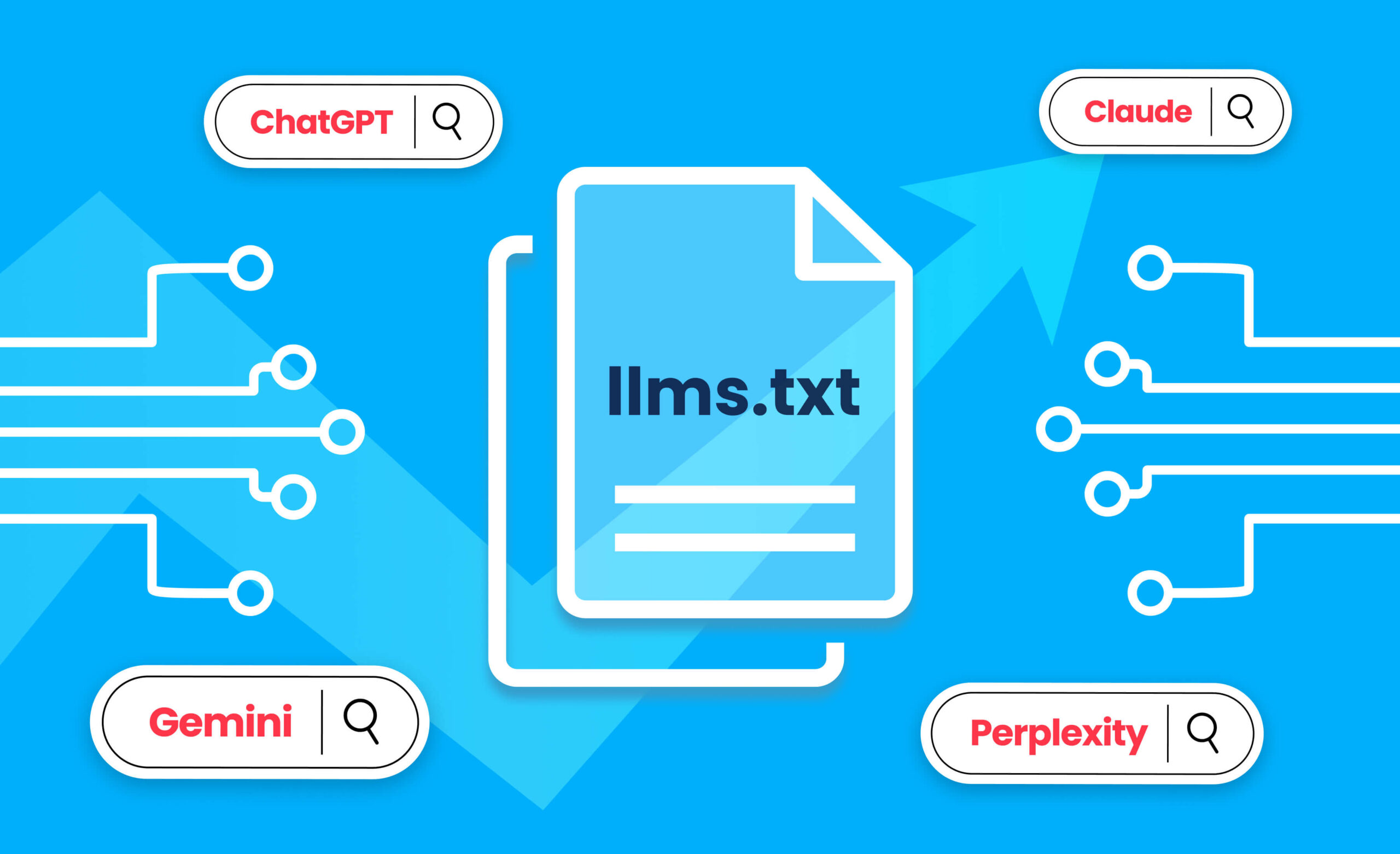
That “simple file” is something called an llms.txt file, and if you’ve never heard of it, you’re not alone – most of our clients hadn’t either. It’s a single plain-text file sat in the root of our site, doing one job: telling AI models exactly what we do, who we help, and where to find the pages that explain it properly.
We didn’t expect fireworks. But since adding it, users arriving from AI assistants are up by around 65%, and visits from AI assistants are up by around 70%, mostly people landing on our site having come straight from ChatGPT: people who’ve asked an AI assistant a question, been pointed our way, and clicked through.
That’s worth paying attention to. So here’s what an llms.txt file actually is, what we’ve seen since adding ours, and the steps we’d give any business that wants to show up when someone asks AI instead of Google.
What actually is an llms.txt file?
Think of it as robots.txt’s newer, more talkative cousin. Robots.txt tells search engine crawlers where they can and can’t go. An llms.txt file does something different: it hands AI models a clean, curated map of your site’s most important content, written in plain markdown, sitting quietly at yoursite.com/llms.txt.
From an AI’s point of view, a normal web page is mostly noise: navigation menus, cookie banners, scripts, ads. All of that eats into the limited amount of information a model can usefully process in one go. An llms.txt file strips that away and hands over the essentials instead: who you are, what you offer, and direct links to the pages that actually prove it.
It’s a young idea, first proposed in September 2024, and it’s still not a fixed, universally honoured standard. Not every AI crawler treats it the same way, and no major AI platform has publicly confirmed it’s a deciding factor in what gets recommended. But it costs an afternoon to set up, several AI crawlers do reference it, and it fits neatly inside a much bigger shift: people asking AI answer engines instead of typing into a search box. More on that below.
What we’ve actually seen since adding ours
Honest answer: this is correlation, not scientific proof. We can’t isolate one text file from everything else we do: our content, our case studies, our technical SEO. But since ours went live, our AI referral traffic (mostly from ChatGPT, with some from Claude and Gemini too) has climbed in a way it simply wasn’t before.
People are arriving at our site having already asked an AI something like “who’s a good web design agency in Reading”, and turning up already warmed up, already trusting the recommendation they’ve just been handed. That’s a different kind of visitor to someone scrolling through ten blue links, and it’s exactly the kind we want more of.
We’re not claiming the llms.txt file did this on its own. What we will say is: it’s a low-effort, zero-downside addition that sits alongside everything else you should be doing to earn a place in an AI’s answer. For us, the timing lines up too closely to ignore.
Why this matters beyond one text file
We’ve written before about the four pillars your business needs to be visible today: SEO, GEO, AEO and AIO. An llms.txt file is one small, practical piece of the GEO and AIO puzzle, but it only earns its keep if the rest of your foundations are solid too.
The businesses that get recommended by AI tools aren’t the ones gaming a single file. They’re the ones that are genuinely easy for a model to find, understand, trust and cite: technically, structurally, and editorially. That takes a bit more than one file. Here’s where to start.
Steps to get your site AEO, GEO and AIO ready
1. Add an llms.txt file to your site root. Keep it simple: an H1 with your business name, a one-line summary of what you do, and a short list of links to your most important pages (services, case studies, about, contact). Ten minutes of writing, dropped straight into your site’s root directory.
2. Check your robots.txt isn’t blocking AI crawlers. If bots like GPTBot, ClaudeBot, PerplexityBot or Google-Extended are disallowed, you can’t be read, understood, or cited, no matter how good your llms.txt file is. Worth a two-minute check.
3. Add structured data to your key pages. Schema markup (Organisation, FAQ, Article, Review) gives search and AI engines a machine-readable version of your content, rather than making them guess from the layout.
4. Write content that answers real questions directly. Headers phrased as actual questions, with a clear, concise answer in the first sentence or two underneath. That’s what gets lifted into AI Overviews, featured snippets, and voice assistant answers.
5. Keep your brand information consistent everywhere. Your name, description, services and locations should match across your website, social profiles, directories and any press mentions. AI models build trust from consistency. Contradictions make them hedge or skip you altogether.
6. Publish genuine expertise, not generic filler. Whatever tools you use to help write it, your content needs real insight, human editorial oversight, and a voice that’s actually yours. AI models, and increasingly search engines, are good at spotting content that reads like everyone else’s.
7. Track your AI referral traffic. Add a segment in GA4 (or your analytics tool of choice) for referrals from chatgpt.com, perplexity.ai, gemini.google.com and copilot.microsoft.com. You can’t tell what’s working until you can see it.
Get your site ready for how people actually search now
The way people find a business has changed, and it’s not changing back. Some of your next clients will still Google you. Plenty more will simply ask an AI and click through on whatever it tells them.
At Above Digital, we build bespoke websites that are designed to perform across all of it: for the people who search, and increasingly, for the AI models answering on their behalf.